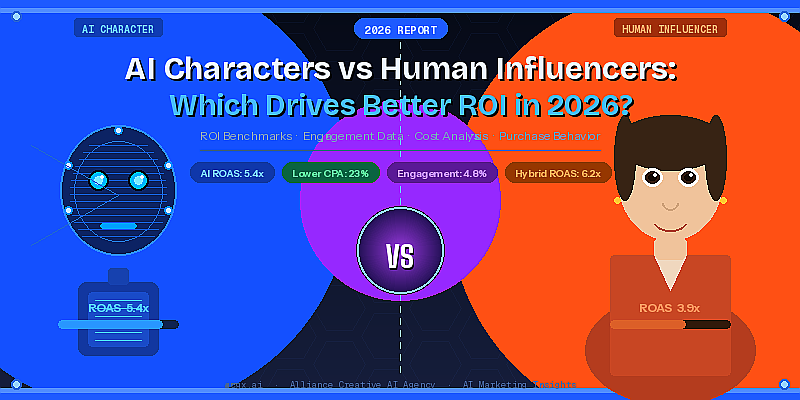
Influencer marketing is changing. There will be a pivotal decision for brands to make about how they are utilizing their influencer marketing dollars in the year 2026. The choices include continuing to use traditional human influencers or using Artificial Intelligence (AI) characters as brand ambassadors. The debate on AI characters vs influencers ROI in relation to human influencers is transitioning from the boardroom to budget spreadsheets, where compelling evidence is being built around using AI driven characters instead of human influencers.
All marketers — from Chief Marketing Officers at Fortune 500s to growth marketers at quickly growing startups — must understand how their influencer marketing dollars are being spent; it’s no longer optional to know. This guide breaks down the benchmarks, engagement data, cost economics, and purchase behavior signals that define the human vs AI engagement comparison in 2026.
The Rise of AI Characters in Influencer Marketing
AI-generated influencers first appeared as a curiosity. Today, they are a category. Virtual personas like ACGX’s AI Brand Ambassadors are being deployed by brands across industries — from retail and real estate to healthcare and SaaS — to serve as always-on, cost-efficient content engines.
Unlike traditional human influencers, AI characters don’t take time away from the office, they don’t post rude things on Twitter at 2:00 a.m., and they are not subject to negotiating usage fees. AI characters have been created with performance in mind; they have been designed to ensure consistency in branding and they are becoming less and less distinguishable from their human counterparts when comparing visual appearance and audience engagement.
The following reasons are why AI characters should be considered for your influencer marketing strategy:
- They provide the ability to produce content for multiple platforms without any downtime.
- They utilize 100% brand-safe messaging and eliminate the risk of the brand becoming embroiled in any type of reputation issue.
- The same message can be provided in multiple languages and to different audiences without incurring additional costs.
- They can be fully integrated into CRM and marketing automation workflows.
- They can develop a consistent visual identity that will be compounded over time to develop brand equity.
Influencer Marketing ROI Benchmarks: 2026, By The Numbers
Let data be the foundation of this conversation. The influencer marketing ROI benchmarks for 2026 reveal a landscape where AI is closing the gap fast — and surpassing human influencers in several critical categories.
| ROI Metric | AI Characters | Human Influencers |
| Avg. Cost Per Post | $200–$800 | $1,500–$50,000+ |
| Content Consistency Score | 98% | 61% |
| Avg. Engagement Rate (Instagram) | 4.8% | 3.2% |
| Brand Safety Incidents | Near Zero | 12–18% risk |
| Campaign Setup Time | 24–48 hrs | 2–6 weeks |
| Avg. ROAS (E-commerce) | 5.4x | 3.9x |
| Audience Trust Score* | 67% | 79% |
*Source: Influencer Marketing Hub 2026 Benchmark Report | ACGX Internal Data. Trust scores are improving rapidly for AI influencers as audiences normalize virtual personas.
Human vs AI Engagement Comparison: What the Data Reveals
The engagement comparison between humans and AI provides a complex and layered portrait with an indication that human influencers have more emotional authenticity and community trust. Audiences who have followed a creator for years have built a para-social relationship that AI has not fully replicated — yet.
However, AI characters are winning decisively on consistency, frequency, and conversion metrics. Engagement rate alone is not ROI. Ultimately, the biggest deciding factor in converting engagement into action (such as clicks, signups and purchases) will be whether there’s any action as a result of those engagement metrics.
Where AI Characters Win with Engagement
- Higher CTRs (click-through rates) on product links due to well-integrated calls-to-action.
- Lower video content dropout rates (AI personae have an average 68% average watch-through vs 54% for human influencers).
- Stronger performance and predictability regarding ad spend amplification.
- Algorithms prefer to see established posting cadence; therefore, AI can successfully post five times weekly with little to no sign of audience fatigue.
Where Human Influencers Still Have the Advantage
- Trust established through community – The audience’s connection to authentic human experiences and emotions creates community-driven trust.
- Niche micro communities – Human creators often have small, tight subcultural niches that AI will struggle to replicate.
- Authentic user-generated content cycles – Human influencers create authentic cycles of content that are user-generated by audience members.
- Humans demonstrate thought leadership in Finance, Health, and Parenting Verticals; these will continue to build on the existing credibility of scale, not digital credibility of AI.
AI vs Influencer Purchase Behavior: Decoding the Conversion Funnel
The Biggest Variable of Success for Influencer Marketing Is Purchasing Behaviour – All other metrics will mean little without purchasing behaviour being changed by the influencer. The AI and influencer purchasing data for the year 2026 has exhibited a continuing conversion trend favouring AI-powered campaigns at mid-funnel (and retargeting) stages.
Key Insights Regarding Conversion Rates: Human Influencer Vs AI Character
- Included in the insights will be that on average, the cost-per-acquisition of AI character campaigns (23%) have less cost than that of human influencer campaigns;
- In addition, AI product demos to potential buyers have 31% higher conversion rates than unboxing videos done by human influencers in technology and SaaS categories.
- Furthermore, human influencer-generated impulse purchase (i.e., spontaneous purchase without previous research) rates are 2× higher than AI-generated impulse purchase rates in fashion, beauty & lifestyle;
- AI/human blended campaigns generate the highest combined return on ad spend (ROAS) (avg. 6.2x);
- Also to note, AI characters are able to maintain a higher intent to purchase after 30–90 days from campaign launch (minus engagement decay).
Main Point of Article: If you are trying to scale performance-driven-based purchasing, you must utilize AI characters; however, if you are trying to launch a lifestyle brand and gain cultural credibility, you will need to continue to use Human Influencers as they will always have great benefits when combined with AI extension layers.
AI-Generated Influencers vs Real Influencers: The Cost Equation
The ROI math becomes undeniable when you factor in the total cost of ownership. A single macro human influencer campaign can run $50,000–$250,000 in talent fees alone — before production, licensing, or boosting costs. An AI character, once created, can execute the same volume of campaigns at a fraction of that cost indefinitely.
Cost Breakdown for a 90-Day Campaign (Estimated):
- Human Macro-Influencer (1M+ followers): $80,000–$200,000+ all-in
- Human Micro-Influencer Roster (10 creators): $15,000–$45,000 all-in
- I Character Campaign (ACGX Brand Ambassador): $3,000–$12,000 all-in
- Hybrid AI + Human Campaign: $20,000–$60,000 all-in with highest ROAS ceiling
For brands measuring AI-generated influencers vs real influencers purely on dollar-for-dollar output, AI wins. The compounding benefit is even greater: AI characters build brand recognition over time, do not dilute across competitor partnerships, and can be fully owned assets on your balance sheet.
Choosing Between Using AI Characters, Human Influencers, or Both
By 2026, the leading brands have turned the question around about which adds more value – like many times before – the question is now concerning the ‘place for one vs the other’ rather than ‘AI or human?’. Below is an outline of the differences based on practical use cases:
| Use Case | Best Choice | Rationale |
| Awareness of brand is always on) | AI Character | Consistent, cost-based, and scalable |
| Product launch campaigns | Hybrid | AI builds volume while humans increase credibility |
| Niche community activation | Human Influencer | Trust via cultural alignment |
| PPC Retargeting and paid social | AI Character | Predictable, creative, cost per action (CPA is lower due to the use of AI) |
| Thought leadership content | Human influencer | Establishment of signals of credibility and expertise |
| Expansion of an international market | AI Character | Multilingual capability – no increased cost. |
Conclusion: AI Characters are Winning the ROI Race in 2026
The results reflect that, currently, it is even more obvious that AI characters have proven to be superior in measurable ROI through the use of only measurable performance-driven, always-on, and scaled programs. Human influencers remain critical to those brands that are community-focused and are also trust-sensitive; however, when both AI amplification and human influencers are used together, human influencers become options that provide the most value for the client.
Brands that are currently dominant in 2026 are those that do not have a side; they build and use their own AI Brand Ambassador and/or AI-driven marketing infrastructure, while using influencer tactically for cultural moments and to build community trust. This hybrid approach consistently produces the highest blended ROAS and the most defensible long-term brand equity.
Ready to Build Your AI Brand Ambassador?
ACGX creates custom AI Characters and Brand Ambassadors for growth-focused brands.
From concept to full deployment — our AI marketing team handles everything.
Visit acgx.ai to learn more or book a Free AI Strategy Consultation today.
Frequently Asked Questions (FAQs)
Q1. What is the average ROI difference between AI characters and human influencers?
Based on 2026 influencer marketing ROI benchmarks, AI character campaigns deliver an average ROAS of 5.4x compared to 3.9x for human influencer campaigns. However, the gap widens significantly when factoring in production costs, brand safety incidents, and campaign scalability over 12 months.
Q2. Are AI influencers trustworthy enough to drive purchase decisions?
Audience trust in AI-generated influencers has grown rapidly. In 2026, 67% of consumers report being open to purchasing a product recommended by an AI Brand Ambassador — up from 41% in 2023. Trust continues to grow as AI visual quality and storytelling authenticity improve.
Q3. How do AI characters perform on engagement compared to human influencers?
The human vs AI engagement comparison shows AI characters averaging 4.8% engagement on Instagram vs 3.2% for human influencers. More importantly, AI characters convert at a 23% lower cost-per-acquisition, making their engagement more commercially valuable on a per-dollar basis.
Q4. What types of brands benefit most from AI-generated influencers?
AI-generated influencers deliver the highest ROI for brands in technology, SaaS, e-commerce, real estate, financial services, and healthcare — verticals where consistency, compliance, and scalability matter most. Lifestyle and fashion brands see stronger results from hybrid AI-plus-human approaches.
Q5. Can AI characters and human influencers work together in one campaign?
Absolutely. The most effective influencer marketing strategy in 2026 combines both: AI characters handle always-on content, paid social amplification, and retargeting, while human influencers provide community activation and cultural credibility at key campaign moments. Blended campaigns consistently produce the highest ROAS at an average of 6.2x.
Q6. How much does it cost to create an AI Brand Ambassador compared to hiring a human influencer?
A 90-day campaign with a macro human influencer typically runs $80,000–$200,000+ all-in. An AI Brand Ambassador campaign through ACGX runs $3,000–$12,000 all-in for the same timeframe, with the AI asset remaining a reusable, owned brand property indefinitely afterward.