Walk into any marketing meeting in 2026, and you’ll hear two camps arguing the same question: do we keep doing what we’ve always done, or do we hand it over to AI? Five years ago, that felt like a theoretical debate. Today, it’s the difference between brands that grow and brands that stall.
Some businesses still swear by billboards and direct mail. Others have replaced their entire sales floor with AI calling agents that never sleep. Most are stuck somewhere in between, trying to figure out which side of the AI marketing vs traditional marketing line their next dollar should fall on.
This article is here to help you decide.
What Traditional Marketing Actually Looks Like
Traditional marketing is the stuff your parents grew up with. It still works in places, but it works slowly, and it costs a lot to find out whether it worked at all.
Most offline marketing strategies fall into a handful of buckets:
- TV, radio, and print ads
- Billboards and outdoor signage
- Direct mail, brochures, and flyers
- Trade shows, sponsorships, and event booths
- Cold calls and door-to-door outreach
The strength of traditional marketing is repetition. Show your brand often enough in the right neighborhood, and people start to recognize you. The weakness is everything else: long lead times, fuzzy ROI, and the painful reality that you can’t tweak a billboard halfway through the month.
What AI Marketing Looks Like in 2026
AI marketing flips the model. Instead of guessing what your audience wants, you let machines figure it out, usually within minutes of a campaign going live.
In practice, that means AI-powered marketing tools doing things humans used to handle: writing ad copy, picking which version to show whom, adjusting bids in real time, and even getting on a phone call to qualify a lead. At ACGX (acgx.ai), we plug in AI Characters, AI Calling Agents, and AI Video Subscriptions so brands can run at scale without hiring a small army to keep up.
A typical AI marketing stack handles:
- Predictive segmentation based on behavior, not just demographics
- Auto-generated text, image, and video creative
- Bid and budget optimization that adjusts every few minutes
- Conversational agents that sell, support, and follow up
- Personalized journeys across email, SMS, social, and paid
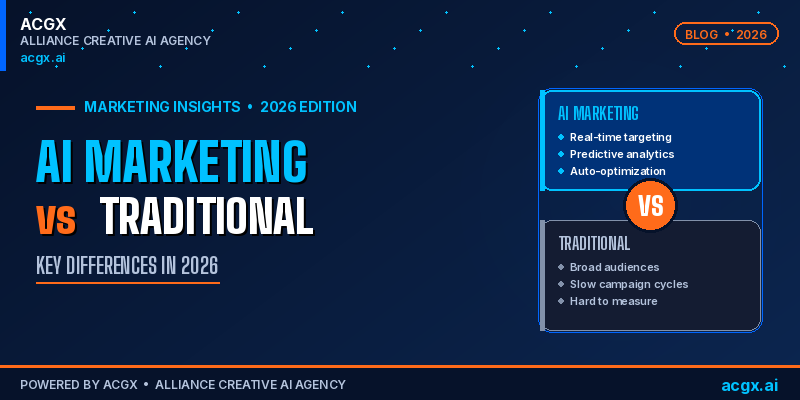
AI Marketing vs Traditional Marketing: Key Differences in 2026
Once you put them side by side, the gap is hard to miss. These are the AI marketing vs traditional marketing differences that show up in almost every account we audit:
- Targeting: Traditional marketing aims at audiences. AI aims at individuals, based on what they actually do.
- Speed: A traditional campaign takes weeks to plan and launch. An AI campaign goes live the same afternoon and starts learning by dinner.
- Cost: TV and print eat into the budget whether they work or not. AI tools cut wasted ad spend by 30 to 60 percent in most accounts we see.
- Personalization: A billboard says one thing to a million people. AI says a million things to a million people.
- Measurement: With traditional channels, ROI is mostly a guess. With AI, every click ties back to a dollar.
- Scaling: Doubling print means doubling print costs. Doubling AI usually means slightly more compute. That’s it.
- Creative: A photo shoot takes a month. AI Video Subscriptions ship branded creative the same day.
- Engagement: A salesperson can dial 50 numbers an hour. AI Calling Agents handle thousands at once, in any language.
Why Brands Are Quietly Moving to AI Marketing
Most of the agencies we talk to in 2026 aren’t making bold press releases about going AI-first. They’re just doing it, quietly, account by account, because the numbers force them to.
Marketing automation platforms have become the brain of the modern stack. They tie email, SMS, social, paid ads, and CRM into one system that runs without anyone watching it. The result is fewer late-night Slack messages and a lot more conversions.
Brands are switching for reasons that are hard to argue with:
- More revenue with fewer people on payroll
- Lead generation that runs at 3 a.m. on a Sunday
- Faster A/B tests across thousands of variations
- Customer journeys that feel personal without being manual
- Live optimization that doesn’t wait for next quarter’s review
The interesting part is what this does for smaller players. A boutique brand armed with the right marketing automation platforms can now outmaneuver enterprises that used to win on budget alone.
So, AI or Traditional? The Honest Answer
Most of the brands doing well in 2026 use both, but the weight has shifted hard toward AI.
Traditional still earns its keep when:
- You’re a hyperlocal business that wins on community trust
- You’re building long-term brand equity that needs physical presence
- Your audience is older, less digital, or both
AI takes over when:
- You need ROI you can prove
- You’re scaling lead generation across markets
- You want personalization without hiring a team to run it
- You need 24/7 sales without 24/7 staffing
The smart play isn’t picking a side. It’s letting AI run the engine while traditional channels handle the parts where a human face still matters.
Related Post –
- AI Branding Solutions
- Custom AI Chatbot Development
- AI Agent Development Services
- Hire AI Video Creator
- Hire AI Automation Expert
Final Thoughts
If you’re still treating this as an either-or question, you’re probably already behind. AI is doing the heavy lifting in 2026, and the brands winning their categories are the ones who figured that out a year or two ago.
That said, AI isn’t a magic switch. It works when it’s set up properly, fed clean data, and built around what your business actually does. That’s the part most companies underestimate.
If you’d rather skip the trial-and-error, ACGX (acgx.ai) builds AI marketing systems end to end. AI Characters, AI Calling Agents, Fractional AI Teams, the works.
Frequently Asked Questions (FAQs)
Q1: What’s the main difference between AI marketing and traditional marketing?
A: AI marketing makes decisions based on live data and personalizes at the individual level. Traditional marketing runs on fixed plans, broad audiences, and a lot of educated guessing.
Q2: Is AI marketing actually better than traditional marketing in 2026?
A: For lead generation, ROI, and personalization, yes, by a wide margin. Traditional still has a place for brand awareness in specific local or older markets, but it’s no longer the default choice.
Q3: What are the best AI-powered marketing tools to use in 2026?
A: Look at predictive analytics platforms, generative content tools, AI calling agents, conversational chatbots, and unified marketing automation platforms. Agencies like ACGX bundle these into a single system instead of making you stitch them together.
Q4: Are offline marketing strategies dead?
A: Not at all. Local businesses, premium brands, and event-driven industries still benefit from print, signage, and in-person touchpoints. The mistake is using offline as your whole strategy instead of a layer on top of AI.
Q5: How does AI marketing actually save money?
A: It cuts wasted ad spend, removes most of the manual creative work, optimizes bids in real time, and replaces repetitive sales and support tasks. Most brands see operating costs drop 30 to 60 percent within the first few months.